How I master a Suno song—or an existing Udio export—before release
Generated music does not need a magic “AI mastering” preset. It needs the same thing every mix needs: a clean source, an honest measurement and restraint when the evidence is ambiguous.
I started this test expecting generated tracks to arrive clipped, bandwidth-limited or obviously unfinished. The four direct Suno WAVs I measured did not. They contained no detected clipped runs, reached 17.4–20 kHz and had useful peak headroom. The thing they consistently lacked was not “human warmth”; it was finished delivery level.
First, get the best source you can actually export
For Suno, use the highest-quality download available to your plan. Suno’s current help says WAV downloads require Pro or Premier on the website; mobile downloads default to MP3. Suno Studio can export a full mix and multitracks as WAV. Its August 2026 documentation also says Studio 2.0 can export 32-bit WAV or MP3.
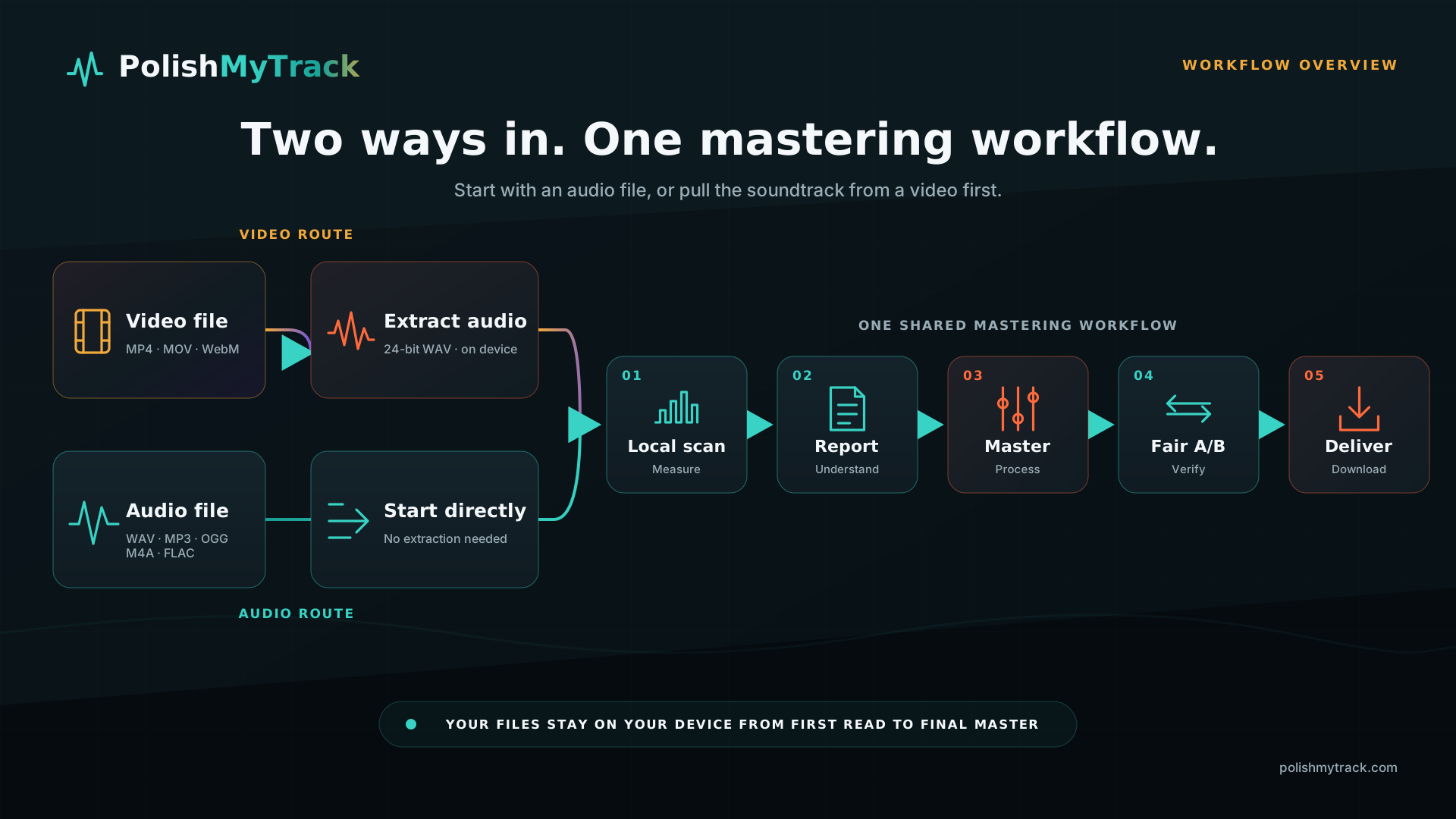
If you only have a video you created, extract the embedded audio locally instead of sending the whole file to a converter site. If you have WAV and MP3, start with WAV. Mastering cannot recover information already removed by a lossy encode.
Measure before deciding what is wrong
My four direct Suno files measured −14.1 to −13.3 LUFS and −4.0 to −2.5 dBTP. Eleven purchased human masters measured −11.4 to −7.3 LUFS and −1.6 to +1.7 dBTP. That does not mean every Suno track should be pushed into the loud range of those records. It means a delivery-level change was plausible, while automatic claims about mud, harshness or origin were not.
The sibilance trigger fired on all four Suno tracks—but also on nine of eleven human masters. Narrow resonances appeared in one Suno file and five human masters. Those overlaps forced me to remove acoustic “AI detection” and generic automatic de-essing. Metadata that explicitly declares Suno is strong provenance; a bright cymbal or synth line is not.
The release pass I recommend
- Export the full mix at the highest available quality. Keep the original untouched.
- Scan the whole track. Check integrated loudness, true peak, LRA, clipped runs, stereo correlation and the tonal report.
- Read the reason for every proposed move. If the explanation reduces to “this number looks unusual,” leave it manual.
- Master once, then compare twice. First at release level to understand the result; then level-matched to judge tone and dynamics fairly.
- Export a high-quality PCM master for distribution. Audition any AAC/MP3 derivative separately because encoding can create new peaks.
Where mastering helps—and where it stops
Mastering can improve delivery level, true-peak safety, measured tonal gaps, stereo focus and certain repairable defects. It cannot rewrite a weak chorus, fix timing between generated stems or make a vocal performance emotionally convincing. If the arrangement is the problem, go back to the generator or DAW before limiting the stereo mix harder.
That boundary is also why PolishMyTrack sells the scan before the promise: the free report can tell you that a track needs less processing than expected. Premium becomes useful when you want manual control, several formats or a whole release queue—not because I hide the evidence.
Start with the file, not a preset
Drop the export into PolishMyTrack. The scan is free, runs on your device and shows the proposed moves before you commit to them.
Scan and master a track