How to extract audio from video without uploading it
A music video can be gigabytes. Its audio track is usually a tiny fraction of that. A converter should not need a server—or decode every video frame—to give you a WAV.
I built the extractor for the awkward moment when the only surviving version of a song is inside an MP4, MOV, M4V or WebM. The goal is not to “enhance” it during extraction. The goal is to recover the embedded audio faithfully, locally, and move it into a measured mastering workflow.
What local extraction changes
A typical online converter uploads the source, processes it elsewhere and sends a derivative back. That creates three avoidable costs: transfer time, a privacy decision and uncertainty about retention. For an unreleased song, the privacy question matters more than saving a click.
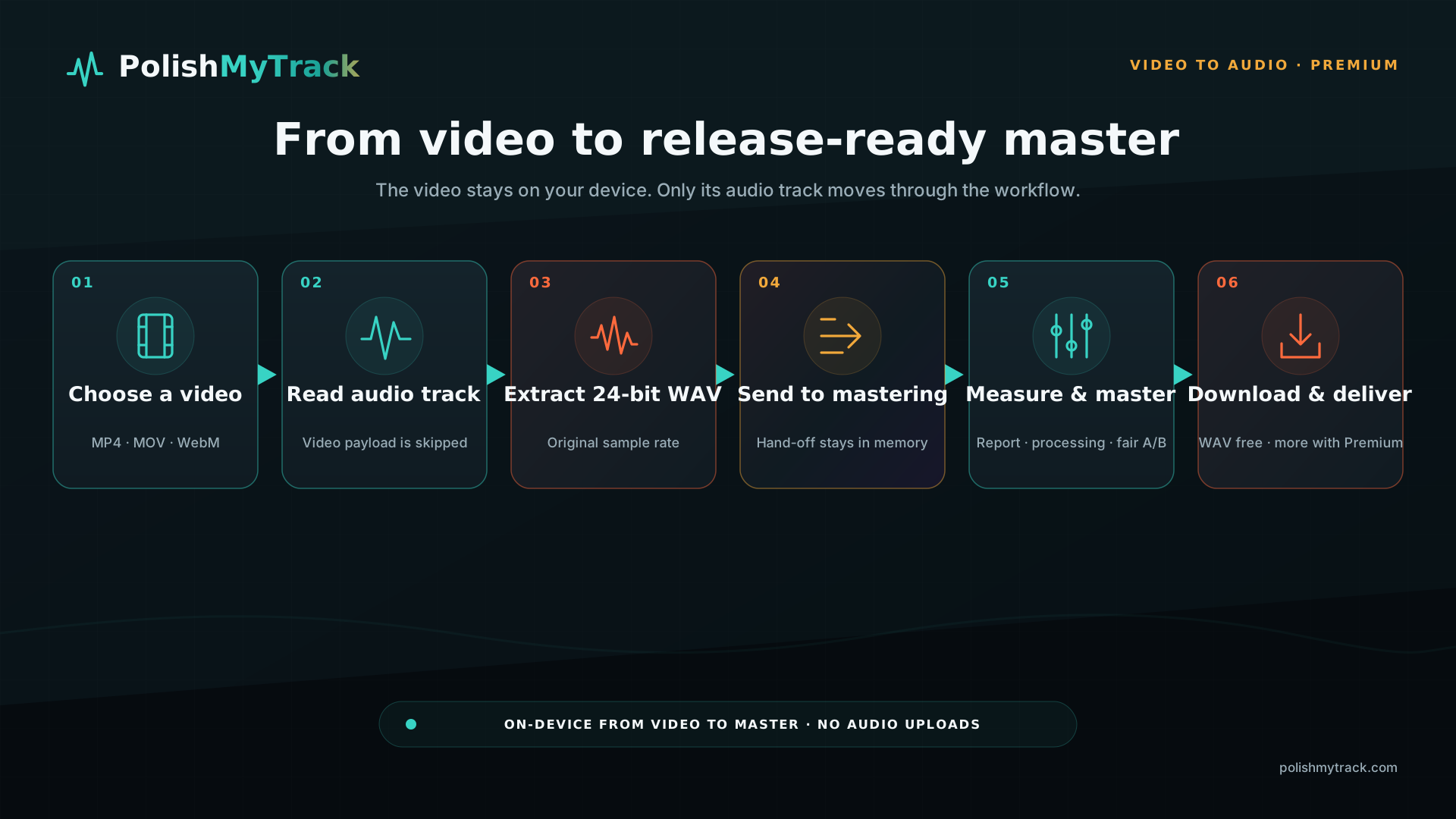
PolishMyTrack uses the browser as the processing environment. It reads the media container, locates the audio stream and decodes that stream locally. There is no audio or video upload endpoint in the product.
Why the extractor does not decode the picture
Video frames are irrelevant when the desired result is audio. For large files, the extractor reads only the byte ranges needed by the audio demuxer where the container permits it. This avoids holding an entire multi-gigabyte video in memory and avoids spending CPU on pixels that never reach the WAV.
If the browser or container cannot support that streaming path, the interface discloses the fallback before reading the whole file. A progress display and cancellation remain available. That matters because “works locally” should not mean “freezes the tab without explanation.”
Extraction is not restoration
If the video contains AAC, extracting it to WAV stops another generation of lossy encoding, but it does not restore frequencies or transients already discarded by the original codec. WAV is the useful working container because subsequent mastering can happen without adding another compression stage.
After extraction, scan the result for true peak, loudness, clipped runs and tonal balance. Video platforms and editing apps can leave unexpected headroom or codec overs. The measurement tells you whether mastering has something to improve; the file extension alone does not.
The three-step workflow
- Choose your own video file. Supported containers are MP4, MOV, M4V and WebM.
- Extract to WAV locally. Keep the original video untouched. Cancel if you selected the wrong file.
- Download or send to mastering. The WAV can move directly into the same browser session without a server round trip.
Why this belongs beside mastering
Extraction is often treated as a disposable utility. For music, it is the first delivery decision. If that step re-encodes unnecessarily, changes sample format silently or uploads an unreleased work, the mastering chain starts with a compromise. Keeping it local and explicit gives the next stage a known source.
Recover the audio, then measure it
Open the extractor, choose your video and keep the whole path on your device. Premium unlocks the large-file extraction workflow; the mastering scan remains free.
Open Video to Audio